
Designing to evoke emotion: when space touches more than the body
From room to experience: the new role of space in hospitality
When someone recalls a stay, they rarely describe the floor plan logic or the square footage. What stays in the memory is the quiet sunrise, the feeling of being protected yet simultaneously connected to the outdoors, the thrill of gazing at the sky without barriers. These are details that are hard to quantify, yet they directly impact how an accommodation is perceived.
That is why designing with emotion at its core is not just an aesthetic gesture, but a strategic decision. It is what allows a brand to differentiate itself in a market saturated with seemingly similar options. And it is, ultimately, what transforms a space into a story worth telling, sharing, or even repeating.
Architecture as a facilitator of emotional connection
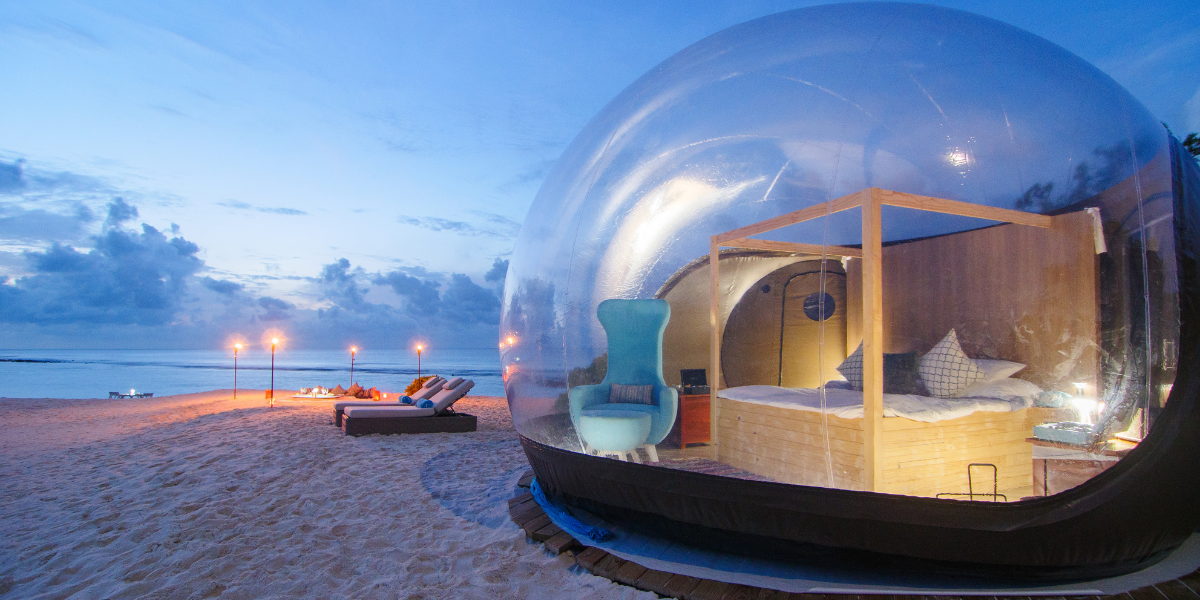
From this perspective, lightweight, demountable, and environmentally respectful architecture, like that offered by Skybubbles, adds a new layer of meaning. This is true not only because of its ability to integrate seamlessly into natural settings without impact, but also because of its knack for offering something increasingly rare: an authentic, immersive, and emotionally powerful experience. Sleeping under the stars, surrounded by silence and free of visual barriers, may seem like a simple luxury, but in reality, it represents a way to reconnect with what is essential.
In these types of structures, every detail is engineered so that attention does not center on the bubble itself, but on what takes place inside it. They are spaces designed to fade into the background and make room for what truly matters: emotion, connection, and memory.

Beyond functional design: a paradigm shift
In this sense, hotels that commit to experiences like those enabled by Skybubbles are embracing a new paradigm—one where luxury lies not in ostentation, but in the lived experience; one where impact is measured less in square meters and more in lasting memories.
Ultimately, the spaces we remember are not the largest or the most complex. They are those that, in some way, have managed to touch something beyond the physical body.
Those who connect emotionally, remember.
And those who remember, return.