
How to transform underutilized areas of your resort into profitable assets
Many resorts face a silent paradox: vast tracts of land, prime locations, and corners with enormous potential… that generate no return. Areas far removed from the main building, spaces with spectacular views but no defined use, areas too small or complex for traditional construction. Spaces that exist, but don’t produce.
Most hotel projects coexist with these underutilized areas, accepting them as part of the landscape, when in reality they could be transformed into high-value strategic assets.
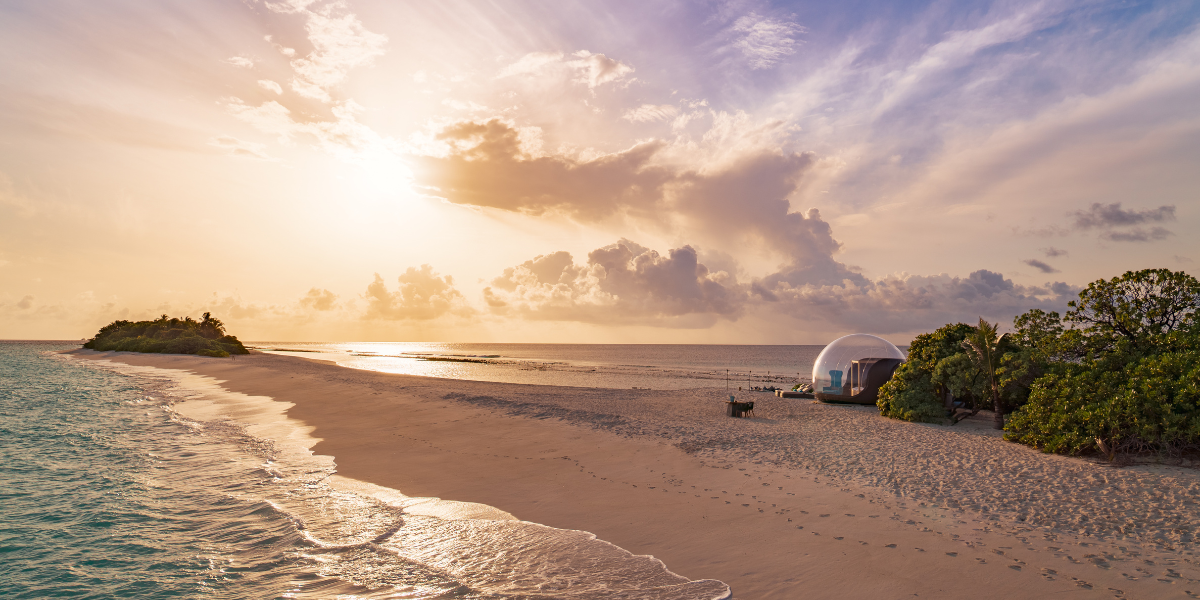
The mistake of seeing the terrain only as an environment
Traditionally, resort design clearly separates the “built” from the “natural.” The building provides accommodation, the environment complements it. However, changing demand has altered this logic: today, the environment is not an add-on, it is a central part of the experience.
Views, privacy, tranquility, connection with nature… what was once considered inaccessible or difficult to access is now precisely what generates the most perceived value for the guest. The problem is not the land itself, but how to activate it.
From underutilized space to experiential asset
Transforming an unused area doesn’t mean building more or disrupting the resort’s balance. It means incorporating an experience that complements the existing offerings and enhances the guest journey.
Skybubbles allow precisely that: activating unique spaces without resorting to traditional construction or major interventions. Their modular design and low impact make them an ideal solution for locations where creating profitable accommodations was previously unfeasible.
But their true value emerges when they coexist with other existing types of accommodations within the resort.
Complementarity that multiplies the value of the set
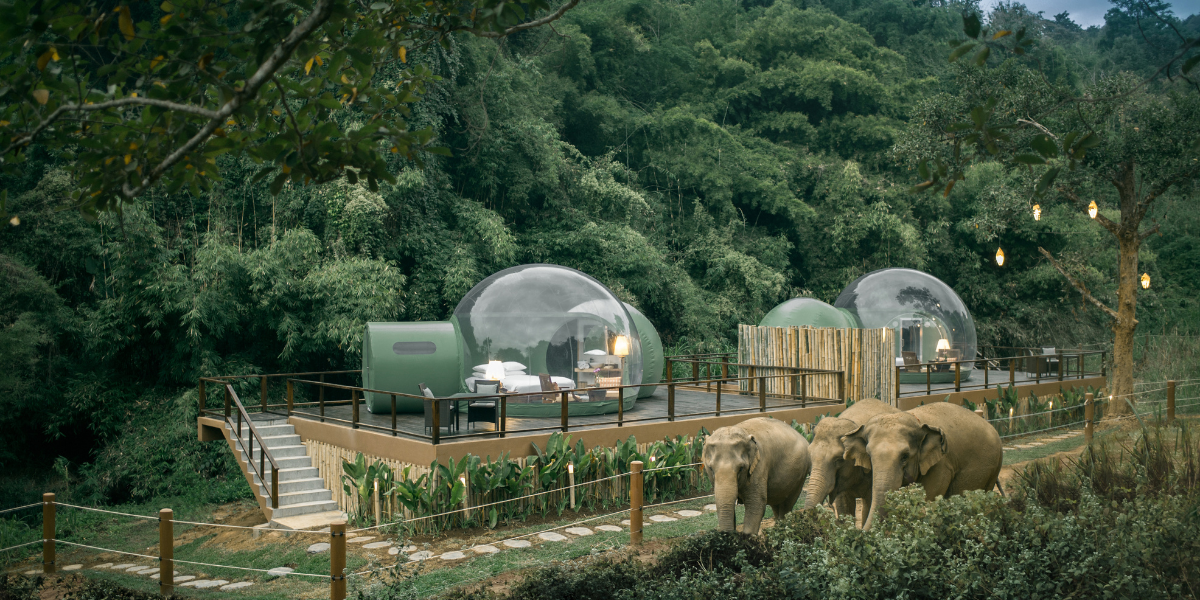
A real-life example illustrates this clearly. A resort with 12 family chalets and 10 Skybubbles observed very revealing behavior among its guests.
Guests staying in the chalets (usually families or groups of friends) discovered the Skybubbles during their stay. The experience, the surroundings, and the concept piqued their curiosity, and many of them returned later as couples to experience Skybubble.
The reverse route also worked. Couples staying in a Skybubble, drawn by the intimate and unique experience, discovered the chalets of the complex. Having enjoyed the surroundings, the service, and the overall concept of the resort, a new idea emerged: “Why not go back to family or friends?”
The result is clear: the same infrastructure generates multiple visits and customer profiles, increasing the value of the guest lifecycle.
Profit without cannibalizing
Because it is a clearly differentiated type of accommodation, there is no direct price comparison or cannibalization. Each accommodation caters to a different stage of the guest’s life, but all of them reinforce the perceived value of the whole.
The real impact on the resort business
- New sources of income are created without expanding traditional work.
- The use of existing land is optimized.
- Customer profiles and reasons for repeat business are expanded.
- The resort’s positioning as an experiential destination is reinforced.
- Customer loyalty and organic word-of-mouth marketing are increased.
All this with a flexible, scalable solution that is aligned with the environment.
Think of the resort as an ecosystem of experiences
Skybubbles are designed for just that: activating spaces, complementing the existing offering, and multiplying the value of each guest. Because, in an increasingly competitive market, it’s not the one with the most rooms who wins, but the one who knows how to create more reasons to return.